30 September 2026
Anti-drone gun: how It works & why tt’s a key military C-UAS asset
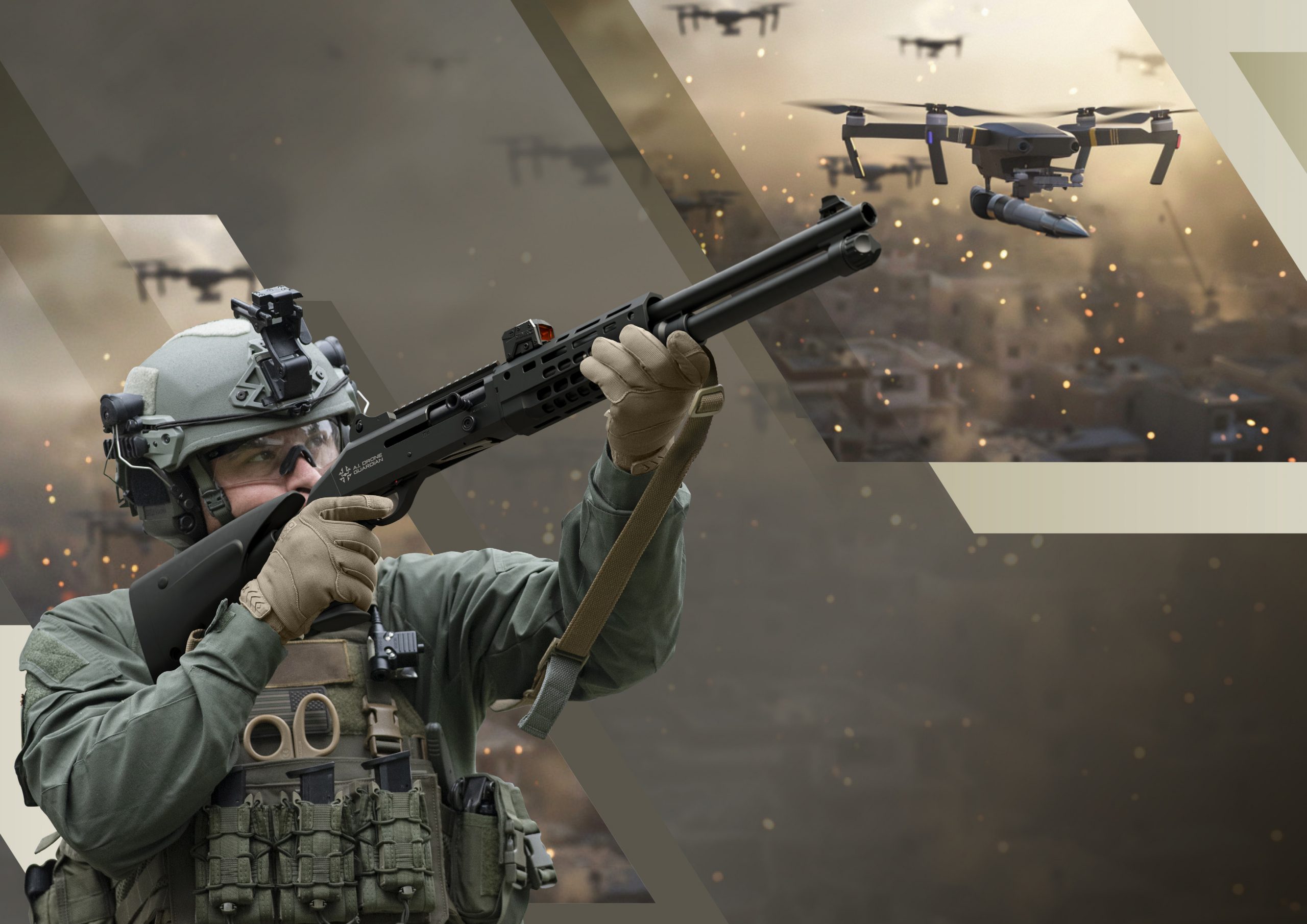
Small Unmanned Aerial Systems (UAS) and FPV drones present an immediate threat to modern military operations. As a vital last line of tactical defense, an anti-drone gun delivers rapid kinetic countermeasures. Beretta Defense Technologies (BDT) meets this threat with an integrated ecosystem combining specialized firearms, dense-payload ammunition, and electro-optics for close-range drone neutralization.
What is an anti-drone gun?
An anti-drone gun is a firearm-based hard-kill solution (most commonly a shotgun or specialized rifle platform) engineered to intercept, physically disrupt, and neutralize low-altitude small Unmanned Aerial Systems (sUAS). It sits within the wider landscape of anti-drone weapons, which spans electronic countermeasures, radio-frequency disruption, directed energy, and automated missile batteries. However, the firearm-based hard-kill system occupies a distinct and indispensable role: it is a self-contained weapon that individual operators can deploy instantly without relying on external radar cueing, satellite networks, or complex command-and-control chains.
When military decision-makers evaluate C-UAS options, a primary point of comparison involves soft-kill electronic systems versus hard-kill kinetic solutions. Non-kinetic devices such as a directional drone jammer gun, an electronic drone jamming gun, or a portable EMP drone gun attempt to disrupt radio frequency control channels or GPS navigation signals. While electronic soft-kill measures are valuable in specific environments, modern combat drones are increasingly hardened against signal disruption through autonomous pre-programmed flight paths, frequency-hopping algorithms, and physical fiber-optic tether wires. In contrast, a physical anti-drone shotgun or tactical anti-drone rifle acts instead as an unjammable anti-drone gun. They function as a definitive drone disabler and immediate physical drone killer gun that destroys the threat regardless of its electronic hardening or degree of autonomy, closing the one gap that soft-kill systems structurally cannot cover.
Deployment flexibility is what makes an anti drone gun military capability effective across such a wide range of tactical scenarios. In fact:
- As a squad or firing-team asset, it can be issued as a shared weapon system within dismounted infantry squads or convoy escort teams, providing overlapping fields of fire and continuous short-range air cover.
- As a personal defense weapon (PDW), it can be carried by individual dismounted operators, vehicle crews, artillery gunners, and command-post sentries who require an immediate, self-contained response to a surprise aerial attack.
- In a point- and perimeter-defense role, it can be positioned at forward observation posts, checkpoints, and high-value installations to instantly neutralize scouting drones probing friendly positions before they can relay coordinates for a follow-on strike.
How does an anti-drone gun work?
The operating principle behind an antidrone gun rests on terminal ballistics, velocity retention, and pattern density rather than single-shot precision. Engaging a fast, low-radar-cross-section sUAS in three-dimensional airspace is an extreme marksmanship problem. A rifle firing one projectile offers a low hit probability against an agile, evasive drone closing at speed, especially under the stress of a surprise attack. An anti-drone shotgun overcomes this by firing a controlled cone of multiple projectiles in a single trigger pull, dramatically increasing the probability of a hit against an erratic aerial target. This principle is far closer to how a soldier is trained to engage a fast-moving target than to a static shooting drill.
This kinetic hard-kill mechanism physically shatters the drone’s carbon-fiber airframe, severs wiring harnesses, destroys propulsion motors, and cracks optical sensors on impact. When paired with purpose-built c-uas ammunition rather than standard lead shot, the effective engagement envelope extends toward 100 meters. That standoff distance gives operators a crucial safety buffer, allowing them to detonate an explosive FPV drone or disable a reconnaissance payload well outside the lethal radius of the munitions it may be carrying.
Environmental resilience is another important operational requirement. Electronic sensors, optical trackers, and RF jammers can lose performance in heavy rain, fog, dust, temperature extremes, or a contested electromagnetic environment. A mechanical firearm platform is, by design, independent of the electromagnetic spectrum: it does not need a functioning GPS constellation, a stable RF link, or protection from directional jamming to work. This is precisely why BDT’s kinetic anti-drone system is positioned as a robust, always-available layer that keeps functioning across arctic, desert, jungle, and maritime conditions, without the power constraints, warm-up sequences, or line-of-sight limitations that affect several electronic countermeasures.
BDT’s anti-drone guns: Benelli M4 A.I. Drone Guardian & Beretta 1301 c-UAS
Within BDT’s integrated ecosystem, two 12-gauge platforms form the foundation of the first, closest-range layer of counter-drone defense: the Benelli M4 A.I. Drone Guardian and the Beretta 1301 c-UAS. Both platforms are engineered to engage aerial threats at ranges up to 100 meters, leveraging semi-automatic actions already validated through decades of demanding military and law-enforcement service around the world.
The Benelli M4 A.I. Drone Guardian is a purpose-built evolution of the M4 semi-automatic shotgun, already fielded by military and law enforcement users in more than ninety countries. Its defining feature is the patented Advanced Impact (A.I.) barrel and choke geometry: an elongated internal cone, roughly ten centimeters long, that reduces pellet deformation as the shot column travels down the bore, increases velocity retention, and maintains a tighter, more uniform pattern density out to extended ranges. In practical terms, this translates into an optimal engagement window from zero to fifty meters, with the ability to reach out to one hundred meters or more in favorable, “borderline shot” conditions, precisely the geometry needed to intercept an FPV drone before it closes to the detonation range of the warhead it may be carrying.
Cycling is handled by Benelli’s self-regulating gas piston system, known as A.R.G.O. (Auto-Regulating Gas Operated), positioned close to the chamber to exploit the hottest, highest-pressure combustion gases. Because the system self-adjusts the volume of gas tapped from the barrel, it maintains consistent cycling reliability whether the operator is running standard buckshot or dedicated anti-drone loads, without manual adjustment. The Drone Guardian is fitted with a telescoping stock in technopolymer, a multi-rail M-LOK fore-end for lights and laser aiming devices, corrosion- and erosion-resistant surface treatments for coastal and desert deployment, and a Picatinny or ACRO-pattern optic interface for fast-acquisition red-dot sights. Its primary purpose is to serve as a “last resort” weapon against small quadcopter FPV drones on the battlefield, or to quickly neutralize a hostile spy drone before it completes its reconnaissance pass.
The Beretta 1301 c-UAS serves as a lighter, highly agile complementary platform within BDT’s first-layer C-UAS role. Built around Beretta’s patented Blink gas-operated action (cycling markedly faster than conventional semi-automatic shotguns), the 1301 lets operators place multiple dense shot patterns on a fast-moving FPV drone in rapid succession, an important advantage when the first burst does not achieve a clean kill. Its optimized balance point, aggressive receiver checkering, and oversized controls (charging handle and bolt release) make the 1301 c-UAS an excellent compact personal defense weapon for dismounted infantry, vehicle crews, and urban tactical units who need to keep a counter-drone capability within reach without adding significant bulk to their standard combat load.
Both platforms share the same dual deployment logic: they can be fielded at squad level to cover a patrol route or a convoy, or carried by an individual operator as a personal defense weapon against a sudden aerial attack.
The ammunition behind the gun: the importance of the right ammunition in c-uas application
A shotgun platform needs dedicated ammunition to function as a genuine hard-kill counter-drone system. Standard lead or steel shot lacks the density and velocity retention required to defeat a composite airframe at extended range. BDT addresses this gap through the its dedicated 12-gauge cartridges engineered specifically for aerial engagements and developed by NORMA, MFS, and RWS, all part of the BDT group of companies. Using 12-gauge shotguns for C-UAS provides an immediate fallback solution for infantries, as it allows regular forces to combat low-altitude drone threats using standard-issue or easily deployable shotguns without needing complex electronic warfare or jamming devices.
Beyond 12-gauge systems, BDT’s ammunition companies continue to extend kinetic C-UAS capability across other calibers, so that a counter-drone effect is not limited to units already carrying a shotgun. Swiss P’s SHATTER4K, for instance, is a multi-projectile round designed to be loaded into standard-issue 5.56mm and 7.62mm service rifles, letting a rifleman switch magazines rather than weapons when an FPV drone appears. RWS, in turn, has developed the Urban Drone Defence (UDD) family of frangible 7.62 x 51 rounds, purpose-built to minimize collateral risk when engaging drones over urban terrain or protected infrastructure. Together, these calibers extend the same design philosophy — dense, purpose-built projectiles rather than modified service ammunition — from the individual rifleman up to fixed-site defense.
Fast target acquisition: Steiner MPS
Tracking a small, fast-moving aerial target against background clutter (clouds, foliage, or urban rooflines) requires a sighting system built for speed rather than magnified precision. Standard iron sights slow acquisition time precisely when the engagement window is shortest, and closing that gap is exactly the role the Steiner MPS rotary-switch reflex sight plays across BDT’s counter-drone shotgun platforms: it is engineered to enable fast, intuitive target acquisition against a moving aerial threat, at the exact moment when an operator has no time to hunt for a sight picture.
That capability starts with an enclosed shockproof housing. An all-metal aluminum chassis protects the optical emitter from dust, water immersion, severe recoil impulses, and dynamic close-quarters handling, keeping the components fully sealed away from the environment rather than merely shielded. This level of ruggedness is not incidental: a small, exposed-emitter red dot cannot reliably survive the sustained firing of high-pressure anti-drone loads, and the same shockproof construction is what gives the optic its reliability in CQB and other fast, dynamic scenarios where the weapon is carried hard, handled roughly, and fired repeatedly under stress.
Target acquisition speed itself comes from the combination of a wide optical window and a crisp red-dot reticle, which together support rapid two-eyes-open tracking. Operators can follow a high-velocity aerial target naturally, estimate the lead needed to hit it, and maintain full situational awareness of the surrounding ground threats, rather than tunneling their attention onto the sight alone.
A rotary switch lets the operator cycle brightness settings by feel, even wearing tactical gloves, without searching for small buttons under stress. That dual benefit matters twice over in a counter-drone engagement, where the operator has to track an erratic airborne target and stay alert to what is happening on the ground at the same time.
Mounted through a low-profile interface that co-witnesses cleanly with the Picatinny rail systems on the Benelli M4 A.I. Drone Guardian and the Beretta 1301 c-UAS, the Steiner MPS holds zero through extended firing cycles, whether against a single persistent drone or a small swarm. This is what positions optics integration as a decisive, and often underestimated, factor in real-world operational effectiveness: pairing a dedicated, ruggedized sight directly with the weapon, rather than leaving operators to rely on iron sights, shortens the gap between target detection and effective engagement – the single largest driver of first-round hit probability in a time-critical air-defense scenario.
Part of a layered C-UAS defense strategy
An anti drone gun is not, on its own, a complete answer to every aerial threat; it is the close-in, immediate layer within a broader, multi-tiered Counter-UAS architecture, creating an integrated anti-drone system.
BDT structures its defensive framework around engagement range, matching a specific technology to each operational zone rather than asking a single system to cover every threat profile.
The first layer (0-100m) is the heart of BDT’s C-UAS offering, and the one where the company concentrates the deepest engineering effort. It combines the Benelli M4 A.I. Drone Guardian and Beretta 1301 c-UAS shotguns, the specialized 12-gauge A cartridge, and the Steiner MPS sighting system into a single, combat-proven package intended to work in any terrain and weather condition. This layer is deliberately built to require no external sensor network, no radar cueing, and no electronic warfare support: an individual operator or a firing team can detect a threat visually and neutralize it within seconds, which is exactly what is needed against a fast, low-flying FPV drone that may already be inbound on an attack run by the time it is spotted. Because it is issued as a shotgun that a soldier already knows how to carry, maintain, and shoot, this first layer integrates into existing small-unit tactics without demanding a new logistics chain or a lengthy fielding process, a decisive advantage when the threat is evolving month to month.
While the first layer provides close-range protection with dedicated anti-drone shotguns, the second layer (up to 150 m) extends that capability to standard infantry rifles. Swiss P’s SHATTER4K ammunition can be fired from conventional 5.56 mm and 7.62 mm service rifles without any weapon modification, allowing riflemen to engage agile FPV drones with a significantly higher hit probability than standard ball ammunition. This layer broadens counter-drone coverage without adding another weapon to the soldier’s loadout.
The third layer (up to 300 m) focuses on the defense of fixed installations, critical infrastructure, and armored vehicles. It combines RWS’s Urban Drone Defence (UDD) low-collateral 7.62 × 51 mm ammunition low-collateral 7.62 × 51 mm with the LIVET eight-barrel Remote Controlled Weapon Station, an automated system developed with DUALEE that integrates multiple Benelli Drone Guardian shotguns with remote operation and auto-tracking. Together, these solutions provide continuous, extended-range protection for high-value sites where persistent aerial defense is essential.
This multi-layered architecture ensures that military forces are never dependent on a single technology to counter every drone threat they encounter. Each layer covers a different range band and a different operational context, so that overlapping coverage (from long standoff distances down to point-blank, last-resort engagements) is available regardless of how the threat presents itself.
Through the combined expertise of its manufacturing companies – Beretta, Benelli, NORMA, MFS, Steiner, RWS, and Swiss P – Beretta Defense Technologies has built a fully integrated, combat-proven ecosystem around the modern anti-drone gun. By pairing specialized firearms with dense tungsten ammunition and rapid-acquisition optics, and by embedding that first-layer capability inside a broader, range-structured C-UAS architecture, BDT gives military and law enforcement forces a practical, reliable way to secure the tactical airspace against the fastest-growing threat on today’s battlefield.
To explore the full range of counter-drone capabilities, firearm specifications, and the multi-layered anti drone system architecture, visit Beretta Defense Technologies.